.svg)
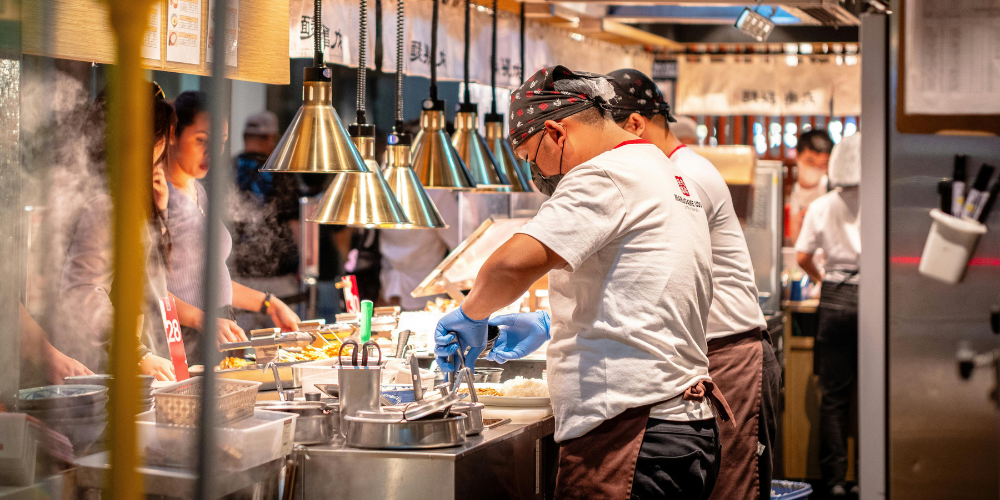
Planning for 2026 in the restaurant industry in the UK means making decisions with hard numbers: labour cost, food costs, demand signals, and the pace of restaurant technology trends. Below is a practical, data-led view of UK Restaurant Industry Trends 2026 for restaurant owners, managers, and decision makers, including online ordering systems, POS systems and sales data, supply chains, food consumption, and customer experience.
Key takeaways (for restaurant owners and operators)
- Labour cost pressure is structural: build productivity into front of house and kitchen staff workflows, not just rota tweaks.
- Protect margin with menu engineering: use POS systems and sales data weekly to manage food costs and menu item performance.
- Digital ordering systems + AI-powered tools can improve speed, accuracy, and guest experience—when integrated end-to-end.
- Resilient supply chains now require multi-sourcing, specification flexibility, and tighter forecasting.
- Food waste reduction strategies are one of the fastest ways to fund upgrades while protecting food quality.
Overview of the UK restaurant industry (why 2026 will feel different)
The restaurant industry has been operating through a volatile period where economy statistics (inflation, interest rates, and wage policy) materially change cost structures and consumer behaviour. For the food - service industry, the winners through 2026 will be the operators who treat technology, menu strategy, and workforce design as one connected system—not separate initiatives.
UK restaurant industry statistics you can plan around (latest published baselines)
The following figures are not forecasts; they are the most widely cited, official or industry-published baselines that affect restaurant operations as you plan restaurant industry trends uk 2026 and uk restaurant industry trends 2026.
- National Living Wage (NLW): £12.71 per hour from April 2026 (UK Government). This directly raises labour cost across front of house and kitchen staff roles.
- Inflation peak reference point: UK CPI inflation at 2.6% in June 2026 (Office for National Statistics). Even as inflation cools, many input costs remain “sticky” in contracts and pricing expectations.
- Food price inflation peak reference point: UK food and non-alcoholic beverages CPI inflation rose by 2.6% in the 12 months to June 2026. This is a key context number when reviewing food statistics, supplier renegotiations, and menu item pricing.
- Interest-rate environment reference point: Current Bank Rate reached 3.75% in August 2026 (Bank of England). This matters for financing refurbishments, equipment, and working capital.
Use these uk restaurant industry statistics to stress-test your P&L for 2026: model labour at NLW plus employer on-costs; model food costs using commodity/supplier scenarios; and model demand using your own sales data rather than “market averages”.
Trend 1: Digital ordering systems become the default (and they must connect to your POS)
Digital ordering systems (QR code ordering, web ordering, in-app ordering, kiosks, and delivery integrations) are shifting from “nice-to-have” to standard infrastructure. The operational value isn’t just convenience; it’s accuracy, speed of service, and structured data for decision making.
What to implement by 2026:
- One menu truth: keep one master menu item list that syncs to in-house ordering, delivery, and bookings.
- Order-to-kitchen routing: reduce re-keying and misfires by pushing orders directly into kitchen display systems where possible.
- Closed-loop reporting: digital ordering should feed POS systems so sales data is complete (dine-in + takeaway + delivery).
Trend 2: AI-powered operations move from experiments to everyday tools
“AI powered” no longer means only marketing copy. In restaurant operations, AI is most useful when it improves decisions that protect margin and the dining experience.
High-ROI uses for restaurant owners:
- Forecasting: demand prediction by daypart to reduce over-prep and food waste (especially for high-spoilage ingredients).
- Labour optimisation: smarter scheduling around known peaks, events, and reservations to control labour cost without harming guest experience.
- Menu engineering support: combining sales data, contribution margin, and prep complexity to highlight which menu item changes matter most.
The key success factor is integration: AI insights need clean inputs from POS systems, reservation platforms, inventory, and purchasing. If your data lives in silos, prioritise that plumbing before buying more tools.
Trend 3: Supply chains and food costs require a resilience playbook
Supply chains in food services remain exposed to global shocks, logistics constraints, and domestic labour availability. The impact shows up as product substitutions, inconsistent quality, and price volatility—each of which affects food quality and the guest experience.
A practical resilience playbook:
- Multi-sourcing critical items: have at least two approved suppliers for high-volume lines (and validate quality equivalency).
- Flexible specifications: define acceptable ranges (size, cut, variety) so kitchens can adapt without reprinting menus weekly.
- Shorter forecasting cycles: re-forecast more often using near-real-time sales data rather than monthly “set and forget”.
- Price-change discipline: create rules for when you re-price a menu item versus when you re-engineer the recipe.
When you review restaurant industry trends, treat food costs as a system: procurement + yield + portioning + waste + pricing. Improving only one element usually disappoints.
Trend 4: Food consumption patterns and menu innovation (quality + value at the same time)
For 2026, the most bankable menu strategy is “quality-led value”: guests want food quality and a satisfying dining experience, but they are also more price-aware. That forces sharper menu item design.
Actions that typically work for full service restaurants and quick-service formats:
- Engineer a value ladder: ensure every section has an entry price, a hero dish, and a premium option.
- Design for throughput: reduce prep bottlenecks so kitchen staff can execute consistently during peaks.
- Use data to refresh: retire low-contribution items faster; test limited-time offers, then scale winners based on sales data.
Trend 5: Food waste reduction strategies become a profitability strategy (not just sustainability)
In 2026, reducing food waste is one of the fastest, least “customer-visible” ways to fund improvements in technology, training, and customer experience. Operators that link waste to ordering, prep, and portion control typically see compounding benefits: fewer stock-outs, better food quality, and better margins.
High-impact food waste reduction strategies:
- Measure first: run a two-week waste audit (prep waste, spoilage, plate waste) and assign a cost to each category.
- Rewrite pars using sales data: align ordering to actual demand by daypart and seasonality.
- Portion and yield discipline: standardise specs and weights; re-train on high-cost proteins and high-waste garnishes.
- Menu design: cross-utilise ingredients across multiple menu items to reduce spoilage risk.
Trend 6: Social media becomes “performance marketing” for restaurants
Social media is still a discovery engine, but by 2026 the expectation is measurable ROI. Restaurant owners should treat content as a performance channel tied to bookings, footfall, and repeat visits—rather than vanity metrics.
What to do:
- Track offers end-to-end: use booking links, promo codes, or tracked QR codes.
- Turn reviews into operations fixes: classify feedback by service restaurant stage (arrival, ordering, speed, quality, payment) and assign owners.
- Promote the experience: highlight guest experience moments: signature dishes, service rituals, and behind-the-scenes quality controls.
Restaurant social media marketing performs best when it matches the on-site customer experience. If the promise doesn’t match reality, reviews will erase the marketing gains.
Trend 7: Front of house redesign to protect hospitality while controlling labour cost
With wage pressure, the restaurant front of house model is shifting. The goal is not to remove hospitality; it’s to move staff time to the moments that matter most to customer experience while letting technology handle transactional steps.
Practical redesign ideas:
- Hybrid service: digital ordering for drinks/repeats, staff-led ordering for first-time guests and higher-value tables.
- Role clarity: separate “host/experience” from “runner” tasks during peaks to improve speed and reduce errors.
- Training for upsell integrity: focus on helpful recommendations, not scripted selling.
What restaurant owners should do next (30–90 day plan)
- Week 1–2: baseline your numbers—labour %, food costs %, top 20 menu items by contribution, and waste hotspots.
- Week 3–6: tighten data—ensure digital ordering systems and POS systems report as one; standardise menu item naming and modifiers.
- Week 7–12: pilot changes—one waste reduction initiative, one service-flow change in front of house, and one targeted social media campaign tied to bookings.
For almost 20 years, 3S POS has offered one of the most flexible EPOS systems and Restaurant Payment Solution. Our clients include international brands such as Caffe Concerto, Chaiiwala, Heavenly Desserts, Pepe’s Piri Piri, GDK and thousands more delighted customers.
If you are looking for an EPOS system for restaurants that will not just help you accept payments but includes inventory management, loyalty programs, and much more, speak to our sales for a free demo.