.svg)

Restaurant operators across the UK are facing a squeeze like never. With energy bills rising, owning a bistro or quick service spot can lose its appeal quickly.
Ingredient costs keep changing.
Business rates are also going up. The reality of the spreadsheet can quickly take over.
In an industry where a single percentage point can mean the difference between expansion and closure, understanding your restaurant profit margins isn't just about accounting—it’s about the ultimate recipe for survival.
What is a "Good" Profit Margin for a UK Restaurant?
If you feel like you are working harder for less, you aren’t alone. On average, restaurant profit margins in the UK typically hover between 3% and 5%. While this might seem slim compared to other sectors, it is the standard reality of the current hospitality landscape.
Margins fluctuate significantly based on your specific service model:
- Full-Service Restaurants (FSR): Often see lower margins (2–6%) due to higher labour costs and overheads.
- Fast Food and QSR: These generally enjoy higher margins (6–10%) thanks to standardised processes and lower staffing requirements.
- Pubs and Gastropubs: Often find a middle ground, with higher margins on "wet sales" (alcohol) helping to balance the tighter margins on food.
Achieving a good profit margin means consistently staying in the black after every expense—from the VAT on a pint to the cost of the garnish—is paid.
Breaking Down the Math: Gross vs. Net Profit Margin
To improve your financial health, you must distinguish between the two primary ways we measure "profit."
1. Gross Profit Margin
This represents the profit made after subtracting the cost of goods sold (COGS) from your total revenue. It shows how efficiently you are pricing your food and managing your inventory.
Gross Profit Margin=Total Revenue(Total Revenue−COGS)×100
2. Net Profit Margin
This is the "real" number. It’s what remains after all expenses—labour, rent, utilities, business rates, and COGS—are subtracted from your total income. This is the ultimate indicator of your business's viability.
The Core Drivers of Profitability
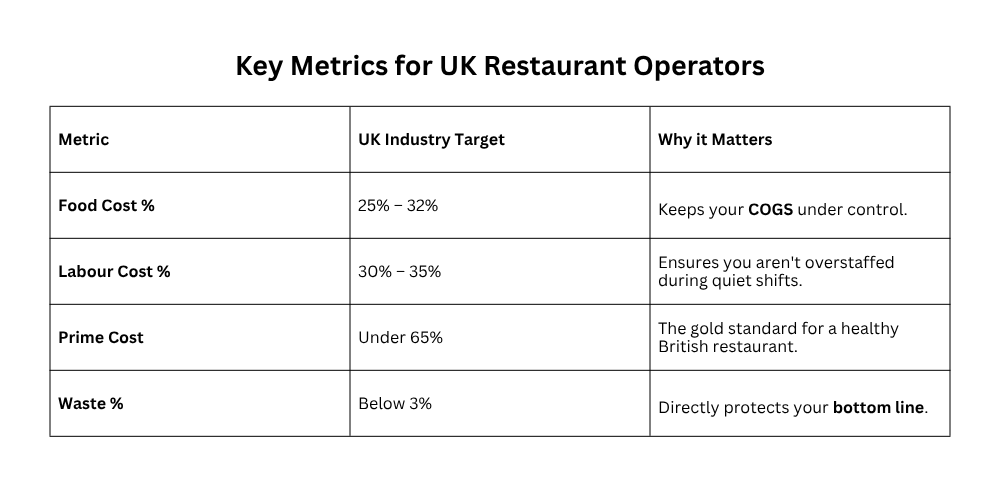
To increase profitability, you have to look at your "Prime Cost"—the combination of food cost and labour.
Understanding Food Cost and COGS
Your cost of goods sold is the total cost of all ingredients used over a specific period. If your food cost percentage is creeping up, your menu price is likely too low, or you have a "leak" in your supply chain, such as unrecorded wastage or delivery errors.
The Impact of Waste
Food waste is a silent profit killer in British kitchens. With the UK hospitality sector throwing away over a million tonnes of food annually, reducing waste and controlling food cost is one of the fastest ways to see an immediate bump in your bottom line. Whether it’s spoilage in the walk-in fridge or over-portioned chips, every gram wasted is money off your margin.
5 Strategies to Grow Your Restaurant Profit Margin
If you want to move the needle from a 3% margin to a healthier 8%, you need a multi-pronged approach that combines data with operational discipline.
1. Master Menu Engineering
Menu engineering is the art of balancing high-profit items with high-popularity items.
- Stars: High popularity, high profit (e.g., a signature pasta dish). Promote these heavily.
- Plowhorses: High popularity, low profit (e.g., Sunday Roast). Try to tweak the recipe to find cheaper suppliers or slightly reduce portion sizes.
- Puzzles: Low popularity, high profit. Rebrand these or train staff to recommend them.
- Dogs: Low popularity, low profit. These are taking up space; remove them from the menu entirely.
2. Optimise Your Menu Price
Inflation impacts the cost of ingredients weekly. If you haven't updated your prices recently, you are likely subsidising your customers' meals. Use a data-driven approach to ensure every dish maintains a consistent gross profit margin. Even a 50p increase on a main course can lead to thousands of pounds in extra total revenue annually without deterring regulars.
3. Tighten Inventory Controls
You cannot manage what you do not measure.
- Shelf-to-Sheet Counting: Perform regular inventory counts to spot "shrinkage" (theft or spoilage).
- FIFO Method: "First In, First Out" ensures that older stock is used first, significantly reducing waste.
- Standardised Portions: Use specific scoops and scales. Consistency protects your margin for a restaurant by ensuring you aren't literally "giving away the farm."
4. Leverage Technology
Modern Point of Sale (POS) systems are more than just digital tills. They provide real-time data on which items are driving your net profit margin. Look for tools that integrate inventory management with sales data to flag when your actual food costs deviate from your theoretical costs.
5. Smart Labour Management
Labour is often a UK restaurant's highest expense, especially with recent increases to the National Living Wage. Avoid "over-scheduling" by analysing historical sales data to predict busy periods. Cross-train your team so that a bartender can help with food prep during a slow lunch, keeping your team lean and efficient.
Final Thoughts: Protecting Your Financial Health
Running a profitable restaurant in the UK requires a delicate balance of culinary passion and financial pragmatism. By focusing on menu engineering, reducing waste, and keeping a hawk-like eye on your cost of goods sold, you can beat the industry averages.
A higher margin provides the "oxygen" your business needs to breathe—allowing you to reinvest in your team, upgrade your kitchen kit, and ultimately, provide a better experience for your guests. Success isn't just about how much money passes through the till; it’s about how much of it stays in the bank.
Are you ready to audit your menu and reclaim your margins? Start by costing out your top three best-sellers today.
For almost 20 years, 3S POS has offered one of the most flexible EPOS systems to international brands such as Caffe Concerto, Maroush, Comptoir Libanais, Pepe’s Piri Piri, GDK and thousands more delighted customers.
If you are looking for an Restaurant POS System that will not just help you accept payments but includes inventory management, loyalty programs, and much more, speak to our sales for a free demo.